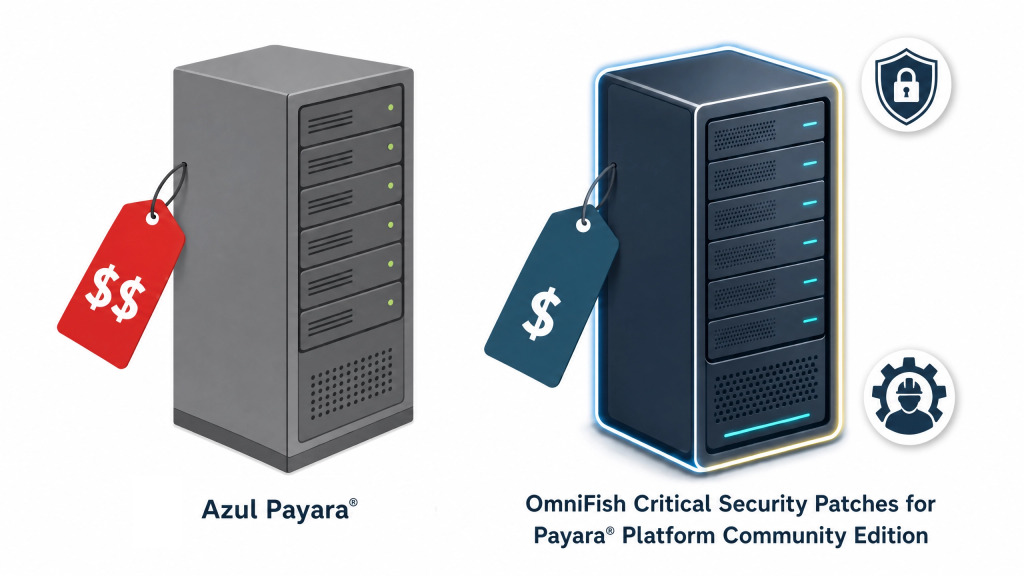
Payara® Enterprise is now a product of Azul Systems, inc., rebranded to Azul Payara®, after Azul acquired Payara last year. Azul® does not publish a price list for these products so the only way to find out what you would pay is to go through a sales conversation. We researched public procurement records to get a clearer picture of what organisations actually pay, and in this article we share what we found and compare it with affordable OmniFish Critical Security Patches for Payara® Platform Community Edition.
OmniFish provides OmniFish Critical Security Patches and support for Payara® Platform Community Edition, a very close alternative to Azul Payara®. In many real-world deployments, the cost of OmniFish Critical Security Patches halves what Azul charges for Azul Payara®. OmniFish Critical Security Patches strictly focus on security and stability, therefore Payara® Platform Community Edition installations with these patches are often much more stable than new versions of Azul Payara® products and provide the same or even more CVE fixes. OmniFish also guarantees top-level support; OmniFish engineers, including 2 Java Champions and the GlassFish project lead, are at the core of Eclipse GlassFish development and have a great understanding of the internals of both GlassFish and Payara® Platform Community Edition, itself derived from GlassFish.
What Azul charges for Azul Payara®
Azul prices Azul Payara® products per CPU core, and every installation counts — production, test, staging, and development alike. There is no published price list; you need to contact their sales team to get a quote.
Since Azul does not publish prices, we went through public procurement records to find out what organisations actually pay. Here are two real examples.
A US Coast Guard contract covers 28 CPU cores and 30 hours of consultancy, at $46,210 per year (around €40,000). That is roughly the scale of a single small production cluster with one or two test environments. In OmniFish terms, this would very likely be classified as a single project. OmniFish support for a single project starts at €12,500 per year — about three times less. That also includes 20 consultancy hours per year, which is similar to the 30 consultancy hours in the US Coast Guard contract with Azul.
A UK NHS contract comes in at £178,563 per year (around €210,000). This is a much larger deployment, almost certainly covering many separate applications and teams. Without knowing the exact breakdown, we estimate that OmniFish pricing for an equivalent setup would be roughly half of that price. OmniFish doesn’t charge for test and staging environments, and pricing scales more favourably across multiple projects.
Both contracts were fulfilled through resellers, which typically adds a margin on top of Azul’s own prices.
A few things can push the cost of Azul Payara® higher than the base subscription:
All environments count. Test and staging CPU cores are charged too. For teams with several test environments, this can be a significant part of the total bill.
Consultancy and migration support is not included. Azul sells it separately through “Accelerator Units,” purchased on top of the subscription.
Legacy version premiums apply if you are still on an older release, with a price increase.
The per-core model is also simply hard to manage in practice. Core counts change as you scale, move to the cloud, or spin up new environments. Estimating your annual cost in advance is genuinely difficult.
What OmniFish offers instead
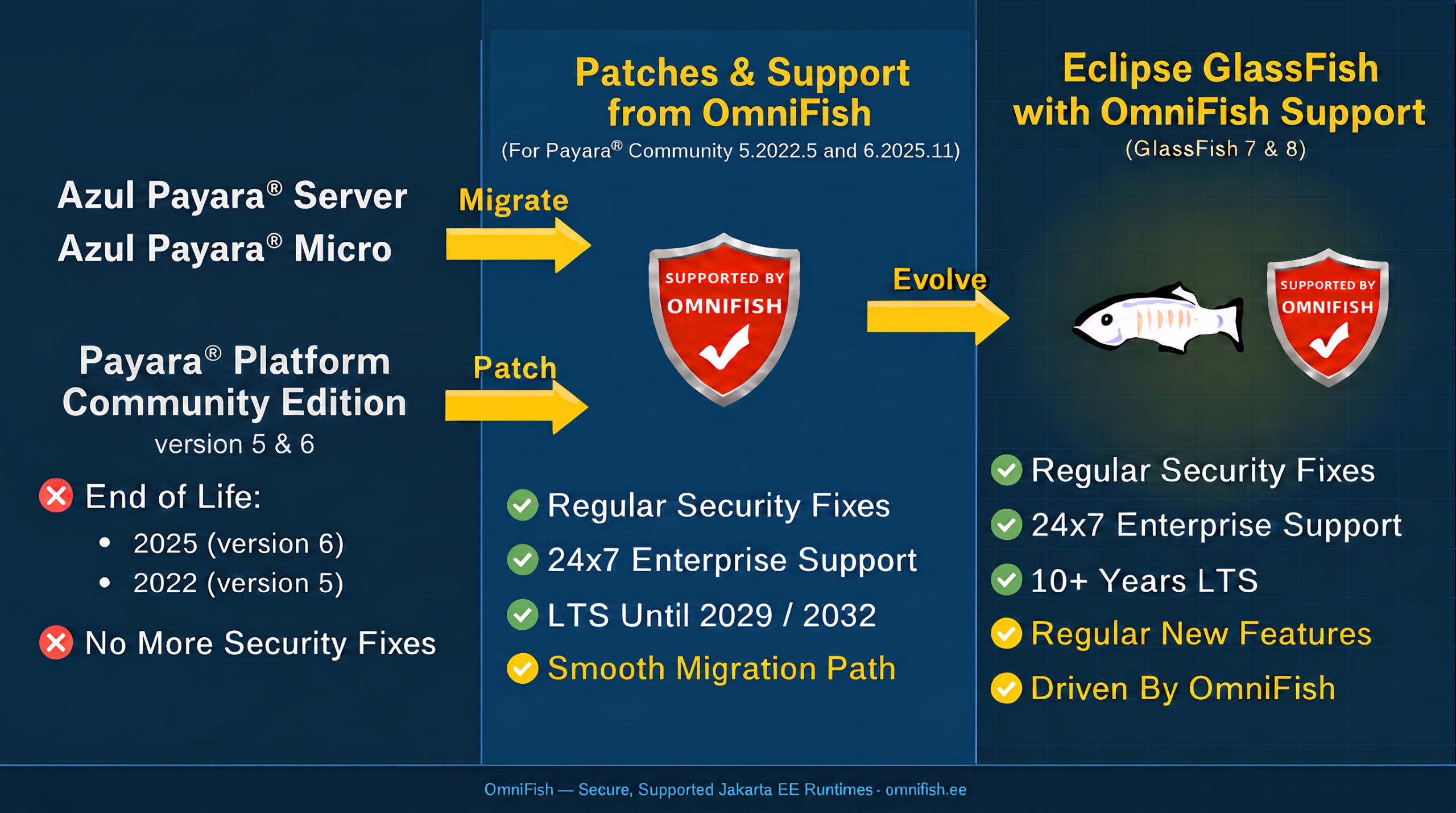
OmniFish provides OmniFish Critical Security Patches for Payara® Platform Community Edition, with prompt CVE fixes, critical patches, and support from OmniFish. They are a true drop-in alternative to Payara® Platform Community Edition and a straightforward migration target from Payara® Enterprise. OmniFish Critical Security Patches are applied to the last version Payara® Platform Community Edition, no application changes needed if you are already using it. OmniFish is aware that Payara® Platform Community Edition doesn’t include some monitoring and management features specific to Azul Payara® and we are ready to help your migrate to an alternative solution with our support. Additionally, OmniFish is leading Eclipse GlassFish development, can implement new features in GlassFish that match your needs, and provides full support for GlassFish as a strong modernized option to migrate to.
OmniFish pricing is structured around projects, not core counts. A project is a single production installation maintained by a single engineering team. Non-production environments (test, staging, development) are included at no extra charge. This fits how real projects actually work much better than a per-core model, and it makes your annual cost straightforward to estimate and budget for.
One important difference from both Azul Payara® and plain Payara® Platform Community Edition: OmniFish Critical Security Patches apply CVE fixes and critical patches without incompatible changes or risky updates. To keep your installations secure, you do not need to upgrade to a new version which also brings other improvements or new features. With older versions of plain Payara® Platform Community Edition, the only way to get official security fixes is to upgrade to the latest major version, which may involve breaking changes and regressions. With Azul Payara®, new versions with patches still often introduce improvements or new features, which may lead to unexpected changes that may suddenly break your application and prevent you from upgrading to the patched version easily.
You are never locked into OmniFish. Customers receive the full source code of each security patch under an open source license and can keep using it even without an active support contract with OmniFish. The subscription provides access to security patches and support — but if you ever stop, all the downloaded patches are free to use under their open-source licenses.
For a typical deployment with several production instances and a handful of test environments, OmniFish Critical Security Patches can cost even half of what Azul charges for Azul Payara® installations. The exact saving depends on how many non-production environments you run and how many CPU cores your contract with Azul is for, but the gap is real and consistent. OmniFish Critical Security Patches are already significantly more affordable than Azul Payara® licenses. Support for Eclipse GlassFish from OmniFish is more affordable still, and with more benefits and further improvements. It’s 20% less than the price of OmniFish Critical Security Patches, making it the best long-term choice provided by OmniFish for teams willing to migrate.
OmniFish engineers are at the core of Eclipse GlassFish development. Our team includes Java Champions and active contributors to Jakarta EE specifications. We understand the internals of both GlassFish and Payara® Platform Community Edition very well — GlassFish is the upstream project that Payara® Platform Community Edition was originally based on.
When you raise a support ticket with OmniFish, you are talking to people who know the codebase deeply, not a support desk working from documentation. This means issues get resolved faster and fixes go deeper.
If you are already on Azul Payara®
There are two practical paths, and OmniFish supports both.
Option 1: Migrate to Payara® Platform Community Edition with the OmniFish migration kit and get access to OmniFish Critical Security Patches from OmniFish. Your application stack stays the same — same codebase, no application changes needed. Your license costs go down significantly, and you get full source code under an open-source licence so you are not locked in. OmniFish Critical Security Patches are applied to the major version you are using, so you do not need to upgrade your installations to stay secure. This is the lowest-friction path.
Option 2: Migrate to Eclipse GlassFish. Eclipse GlassFish is actively developed, production-ready, and commercially supported by OmniFish. OmniFish provides full migration support to help you make the move. And your cost drops even lower. This is the best long-term option for both cost and platform quality.
You can take either path directly, or start with Option 1 and move to Option 2 when you are ready.
Do you use an older version of Payara® Platform Community Edition and want to get CVE fixes without upgrading to a newer major version?
Do you seek support but the price for Azul Payara® is too high for you?
Or you seek an alternative, more hands-on team to get support from?
OmniFish Critical Security Patches on top of will provide you all of that, at a very reasonable subscription price. It would allow you to patch your Payara® Community installations with security patches and with no additional regression risks from upgrading. OmniFish Critical Security Patches are directly applied to Payara® Community and include only the necessary fixes and component upgrades to keep it secure and free of critical defects. Nothing else changes, which makes applying the patches extremely straightforward and risk-free. OmniFish also provides full source code for OmniFish Critical security Patches, so you’re free to continue using and maintain the same platform even if you decide to stop the OmniFish subscription.
In the future, we encourage you to consider migrating to Eclipse GlassFish as the best long-term option for both cost and platform quality. GlassFish is actively developed, production-ready, and commercially supported by OmniFish, even at a lower price than the OmniFish Critical Security Patches. We’ll provide you with full migration support to help you make the move once you’re ready to make this step.
A note on GlassFish and production readiness
If you have heard that GlassFish is not production-ready or not supported, that information is outdated. It was accurate before 2022, when GlassFish was effectively dormant. Since then, OmniFish has taken over active development and commercial support. Eclipse GlassFish now has a regular release cadence, a growing community, and a team of experts behind it. It is used in production by organizations around the world.
That’s why we recommend migrating from Payara® products to Eclipse GlassFish in the longer run. We are directly involved in the Eclipse GlassFish project and contribute improvements and new features to it. Compared to our patches, which only contain urgent fixes on top of Payara® Platform Community Edition, we’re putting a lot of effort into making GlassFish better and more powerful with every new release.
If you want to understand what your specific deployment would cost with OmniFish, contact us. We will walk through your setup and give you a clear picture of your options.